
By Antonia Hernández
I. AFTER A COFFEE POT AND A FISH TANK
Our next guest is the creator of the very popular JenniCam website which televises the life inside her apartment 24-hours a day, live on the internet. Please welcome JenniCam’s own Jenni!
Jennicam’s Jenni on Letterman’s Late Show.
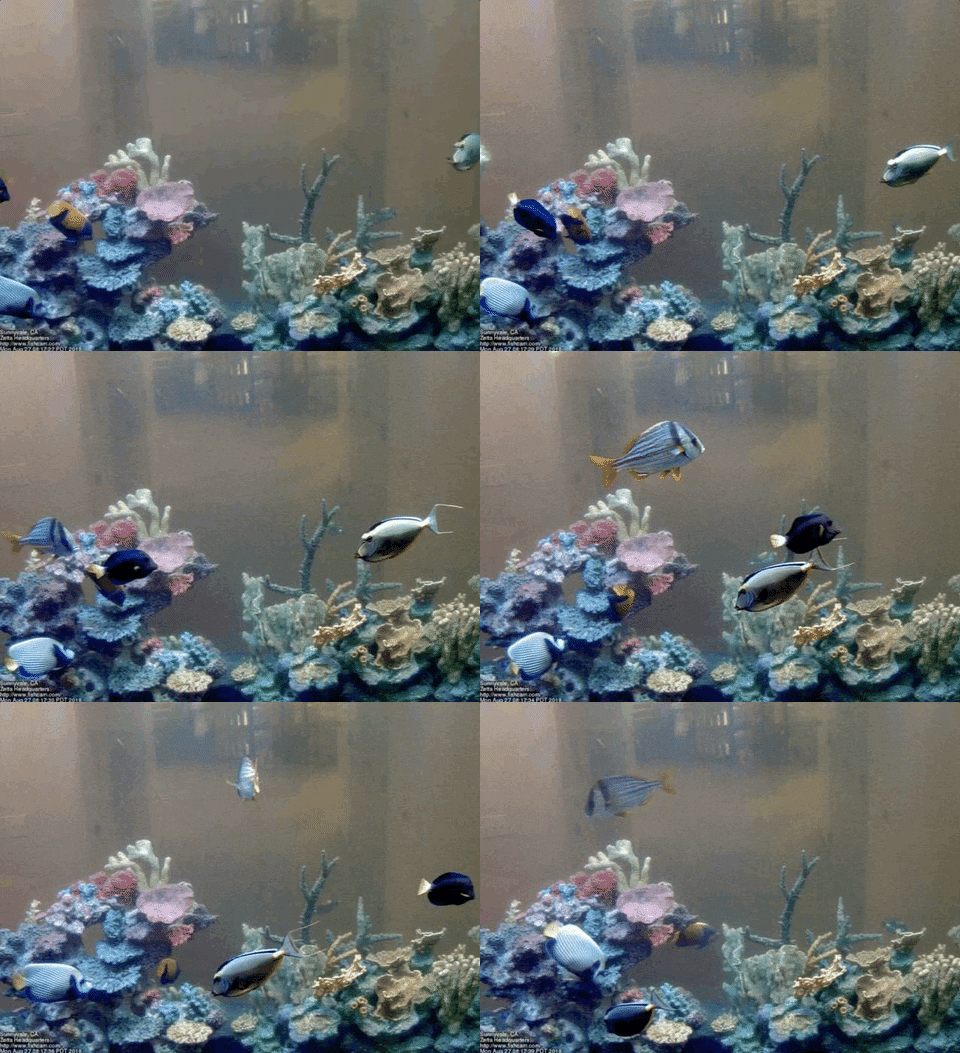
In the beginning was the JenniCam. Or almost. Before Jennifer Ringley, a student from Pennsylvania’s Dickinson College mounted a digital camera on top of her computer in her dorm room on April 14, 1996,3 there was the Fishcam. The Fishcam, set up by Netscape founder Lou Montulli in 1994, broadcasted a new image of a fish tank in California to the brand new Internet every four seconds. And before the fish tank, it was the Trojan Room Coffee Pot (XCoffee) at Cambridge University, which in 1991 helped researchers evaluate if the remaining coffee in the pot would be worthy of a trip.
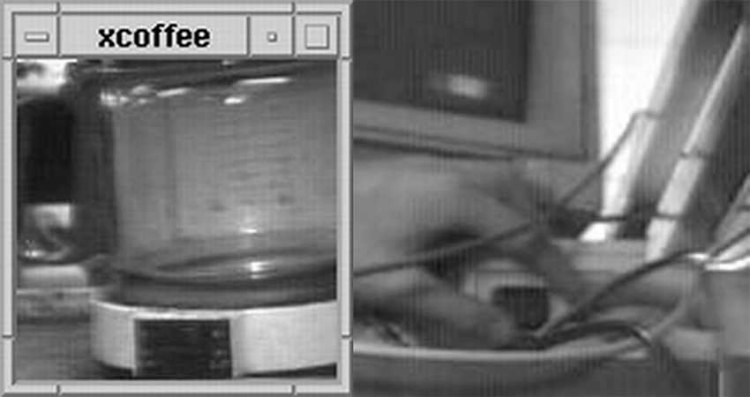
The image shows a frame from XCoffee and its last one, when it was finally switched off at 0954 UTC on Wednesday 22nd August 2001.
It’s late 1991, and 15 or so researchers in the Systems Group at the University of Cambridge Computer Lab share a coffee machine located in a rather uninspiring area known as the Trojan Room. Not all of the researchers are in the Trojan Room, though; others are two or three flights of stairs away and must travel some distance in search of coffee, often to find those closer at hand have beaten them to it. One pot provides enough coffee to fill just a few mugs, so it’s first-come, first-served, and distance is a definite disadvantage. In the interests of fair play, some of the residents of the Trojan Room salvage a video camera, an old 680×0 VME-based computer, and a framegrabber left over from other projects. They grip the camera in a retort stand and point it at the coffeepot. The machine with the framegrabber executes a specially written server program, and an X-Windows client, which can be run by anybody in the group, grabs images at regular intervals and displays a picture of the pot, icon-sized, in the corner of the workstation screen. Those too far away to smell the coffee now have an alternative means of knowing when a new pot is brewed. The Net, once again, helps break down the barriers of distance (even if that distance was only measured in yards), and so streamlines the distribution of a resource so vital to computer science research.
“Personal & Fun / The Trojan Room Coffee Pot | Quentin Stafford-Fraser.”
During its two first years of existence, the circulation of the latest frame of XCoffee was restricted only to the researchers’ computer screens. But in 1993, when an IMG tag was introduced to the Hypertext Markup Language (HTML) for embedding images into web pages (and quickly adopted by the MOSAIC browser), this changed.
We soon realized something that now seems obvious: when your browser requests an image from a server, the server doesn’t have to return the same image every time. For us, the most convenient source of constantly changing images was the coffeepot camera, so [we] modified the server to respond to HTTP requests, and the first Web cam was born.
“Personal & Fun / The Trojan Room Coffee Pot | Quentin Stafford-Fraser.”
The XCoffee, now available for public viewing, became ‘one of the most popular sites on the early Web,’ and by 1996, it had received more than one million hits. As Quentin Stafford-Fraser hypothesized: ‘[i]t became famous for being famous.’ Two years and another million hits later, the coffee pot was no longer described as ‘a novelty’ but as ‘a historical artifact.’ XCoffee’s popularity declined over the years, but it peaked again in 2001 with the announcement of the end of its transmissions. ‘You want to know the secret of getting attention these days? Switch it off.’
II. WEBCAMMING AS A GENRE
A re-examination of the XCoffee and the FishCam shows that, even before the JenniCam, the webcam orbited around matters of contemplation and control. As in a fascinated surveillance, images became sites of verification from where a new/old truth was erected. What Jennifer Ringley did, however, would consolidate the genre. But let’s start with conventions. As explained by Raymond Williams, ‘a convention is an established relationship, or ground of a relationship, through which a specific shared practice–the making of actual works–can be realized.’ Albeit historical, conventions are often naturalized and the ‘inclusions and exclusions, the styles and the ways of seeing, that specific conventions embody and ratify’ become invisible. A critical examination of the early established conventions of webcamming allows tracing the mesh of inclusions and exclusions that sustains it, the concurrence of factors, its particular conjuncture.
Both in the coffee pot and the fish tank, the subject of early webcams was not granted agency and was unable to offer restrictions to its observation. Unlike CCTV, neither monitoring the fish tank nor the coffee pot was of any use to most viewers other than entertainment. Not any entertaining, though, but one based on the contemplation of life happening, slowly, elsewhere–even if the filling and emptying of the coffee pot were not as vivid as the fish. Because of the novelty of the medium, the first webcams were not only transmitting something but broadcasting the evidence of this possibility. The medium was undeniably the message: the first webcams shown their own reflection, with the image of the Internet in the corner of the frame.
A genre, however, is more than a set of conventions. It involves a certain intensification of practices, a folding of relations, a production of regularities. Following Williams once more, a genre ‘is neither an ideal type nor a traditional order nor a set of technical rules’ but the result of the combination of ‘different levels of the social material process.’ A genre recognizes three principal abstract components: stance, mode of formal composition, and subject-matter. The stance is the most general of the three and refers to ‘a mode of basic (social) organization which determines a particular kind of presentation.’ In the case of the webcam, the stance would be what was already determined by the coffee pot and the fish tank: the depiction of an alive (or animated) subject accessed remotely. The mode of formal composition would correspond to the formal elements of webcamming: technical affordances and constraints, format, lighting, duration–the aspect that changed the most since its beginnings. However, it is in the area of the subject and the matter where the innovation of Ringley would be more radical and enduring, as it will be developed. Viewing the webcam as a genre (rather than a form, for example) serves here to show the continuity and changes it has undergone, and to trace the lineage of its current incarnations.

A re-examination of the XCoffee and the FishCam shows that, even before the JenniCam, the webcam orbited around matters of contemplation and control. As in a fascinated surveillance, images became sites of verification from where a new/old truth was erected. What Jennifer Ringley did, however, would consolidate the genre. But let’s start with conventions. As explained by Raymond Williams, ‘a convention is an established relationship, or ground of a relationship, through which a specific shared practice–the making of actual works–can be realized.’ Albeit historical, conventions are often naturalized and the ‘inclusions and exclusions, the styles and the ways of seeing, that specific conventions embody and ratify’ become invisible. A critical examination of the early established conventions of webcamming allows tracing the mesh of inclusions and exclusions that sustains it, the concurrence of factors, its particular conjuncture.
Both in the coffee pot and the fish tank, the subject of early webcams was not granted agency and was unable to offer restrictions to its observation. Unlike CCTV, neither monitoring the fish tank nor the coffee pot was of any use to most viewers other than entertainment. Not any entertaining, though, but one based on the contemplation of life happening, slowly, elsewhere–even if the filling and emptying of the coffee pot were not as vivid as the fish. Because of the novelty of the medium, the first webcams were not only transmitting something but broadcasting the evidence of this possibility. The medium was undeniably the message: the first webcams shown their own reflection, with the image of the Internet in the corner of the frame.
A genre, however, is more than a set of conventions. It involves a certain intensification of practices, a folding of relations, a production of regularities. Following Williams once more, a genre ‘is neither an ideal type nor a traditional order nor a set of technical rules’ but the result of the combination of ‘different levels of the social material process.’ A genre recognizes three principal abstract components: stance, mode of formal composition, and subject-matter. The stance is the most general of the three and refers to ‘a mode of basic (social) organization which determines a particular kind of presentation.’ In the case of the webcam, the stance would be what was already determined by the coffee pot and the fish tank: the depiction of an alive (or animated) subject accessed remotely. The mode of formal composition would correspond to the formal elements of webcamming: technical affordances and constraints, format, lighting, duration–the aspect that changed the most since its beginnings. However, it is in the area of the subject and the matter where the innovation of Ringley would be more radical and enduring, as it will be developed. Viewing the webcam as a genre (rather than a form, for example) serves here to show the continuity and changes it has undergone, and to trace the lineage of its current incarnations.
III. ENTER JENNI
And then the JenniCam appeared. In 1996 Jennifer Ringley, a 19-year-old college student and web designer installed a camera on the top of her computer. She started her experiment as a programming challenge to herself, ‘to see if I could set up the scripts that would take the pictures, upload them to the site[…]kinda “look, I got this working.”‘ Although not her original setup, by
1998 the JenniCam required two different computers,
one Mac and one linux box, networked together through an ethernet hub, connected to my ISP via modem. My linux box uses NFS mount to mount the JenniCam server. Then, my Mac uses MacWebCam to take a picture from my Connectix QuickCam every minute (to keep the picture fresher). Every two minutes, a cron job connects to my mac using ftp and uploads the new picture to my linux box, into the NFS mounted directory.
“JenniCam – Frequently Asked Questions”.
Ringley achieved her goal, but that was not what would make her part of the history of the Internet forever. The revolutionary act was to direct the camera to herself.
Dave Letterman
Was this your idea? You created this? Nobody else had done this before you did, right?
Jennifer Ringley
Right. Before me, there was the coffee pot cam. And where I got my idea from, the fishcam.
Letterman
And this is an aquarium? somebody’s got his camera on the aquarium 24 hours a day, and people watch that? is that what it was?
Ringley
Exactly. And I don’t know if you know fish, but they’re interesting for, like, five minutes.
Letterman
That’s right, that’s right.
Ringley
So, I thought if a person were to do this, that would be more interesting.
Letterman
Now, your little thing that you’ve got going is much better than that aquarium thing.
Ringley Thank you.
Letterman
Don’t worry about a thing. You’ve got no problem with those fish.
Still, the JenniCam had problems that the fish did not. First restricted just to Ringley’s friends, news about the existence of the JenniCam spread quickly, and the website started receiving millions of hits per day. However, unlike the FishCam or the XCoffee, Ringley did not have institutional support and was the sole responsible for the transmission costs that her sudden popularity brought. As Terry Senft recalls, ‘at the height of her popularity […] Jennifer was also at the height of her bandwidth costs.’15 Because of this, she developed in 1997 a paid subscription model where the only difference with the non-paid access was the rate in which the image refreshed–two minutes versus twenty. Ringley was adamant that her goal was to cover transmission costs, not to receive revenue.
I hope you understand how much I hate doing this. I feel like I’m letting everyone down.
I feel like a traitor. I hope you believe me when I say that if there were any other way to
do this, I’d be doing it. If I had the thousand dollars to keep the site free, I would pay it. I would happily give the money to continue the site for free. But the sad fact is I hardly have enough money to cover the bills I have now, let alone my student loans that I have to pay starting next month. I want you to know that I’m not making a penny off this. […] The site isn’t up because I can make money and fame from it. The site is up because YOU continue to enjoy it.
“JenniCAM Guests”, emphasis in the original.
Jennifer Ringley never presented herself as working for the camera, nor performing. As defined by Ringley herself, the JenniCam was
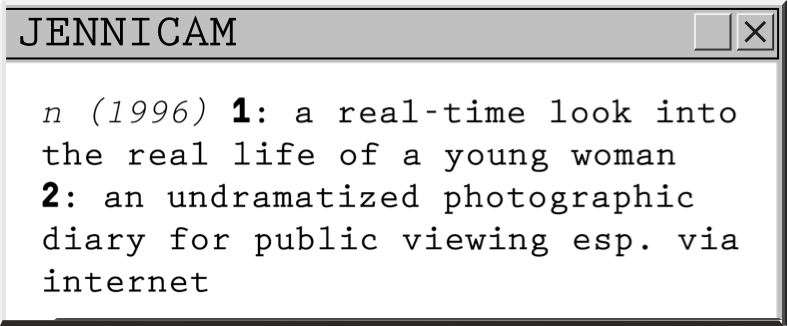
With only a few words, Ringley would define the main components of webcamming for the years to come.
A REAL-TIME LOOK
Despite the small number of images per hour, Ringley was lucid in establishing real-time as the first condition of the JenniCam. Real-time is the time of the Internet, a reparatory term that denies any mediation but requires an intensification that can only be brought out by technology. Real-time indicates both simultaneity and its impossibility: more real than real, but not quite so.
The very idea of a time that is real presupposes an unreal time, a technologically produced and mediated time. ‘Real time’ suggests that represented time (whether mechanical, electronic, or digital) can be asymptotic to the instantaneous — with no delay, no distance, no deferral.
Doane, “Real-Time: Instantaneity and the Photographic Imaginary.”
Real-time is a ‘sufficiently immediate’ time that ‘entails the promise of an experience of the now.’ In this way, real-time was ‘the new crack’:23 the condition for the Internet-version of a common present, the coincidence that demonstrates, finally, that there was someone out there–even if their vital signs update every fifteen minutes.
Ringley’s description of the JenniCam shown her awareness of the medium and the zeitgeist of the time, when the Internet was seen as an unrestricted, yet faceless, collective of potential connections and opportunities. The JenniCam emerged between the ‘deep anxieties about the integrity of identity online’ and ‘the techno dreams of cyberspace as a parallel virtual reality.’25 Without warning, there was Jennifer Ringley: sitting in front of her computer and removing an eyelash from her eye, or petting her cat, or eating ice-cream out of the package. Cyberspace, imagined with psychedelic colors and populated by cyborgs, was suddenly just a 320px by 240px grainy image of a blonde young woman brushing her teeth. And it was fascinating.
Dave Letterman
I want to tell you something. I’ve heard a lot of stuff about the internet […] You know, yadda, yadda, yadda about the Internet. [But] this, to me, is like the perfect idea for the Internet. Don’t you think?
Jennifer Ringley
I think so. I mean, […] if you look around on the internet, there’s so much that, […] as far as broadcasting goes, it’s just like tv on the Internet. I think what it needs is to have something that is made for the medium.
The JenniCam was definitely something made for the medium. Only possible through and because of the Internet, it proved that power was, in fact, going to be redistributed among all connected people, giving a reassuring face to at least one of them.
I was in my dorm room Saturday night doing laundry. I was a nerd! And I got an email from someone who said ‘I’m doing laundry too and I just looked and saw that you’re doing laundry on Saturday night. It’s funny cuz I felt like a loser. I’m sitting at home doing laundry on Saturday night, but I saw you are too! So now I don’t feel so bad.’ And that kind of just did it for me. I was glad to hear that, somehow, I gave somebody permission to just be themselves and to be ok with that.
The real-time look of the JenniCam evidenced what was happening somewhere, without time for ornaments and challenging ‘the “cheesy” conventions of commodified entertainment’28 with the apparently objective view of the camera. The medium was, again, the message. But what did it say?
INTO THE REAL LIFE
Q: Do you ever stage what we see?
A: No. The concept of the cam is to show whatever is going on naturally. Essentially, the cam has been there long enough that now I ignore it. So whatever you’re seeing isn’t staged or faked, and while I don’t claim to be the most interesting person in the world, there’s something compelling about real life that staging it wouldn’t bring to the medium.
There’s something compelling about real life: Not just life but real life, something with a particular intensity, sticky, able to hold people and things in its viscosity. Later, with nine cameras positioned in different parts of her apartment and broadcasting 24/7 during almost eight years, this ‘sort of window into a virtual human zoo’ became a phenomenon that led to thousands of fans and imitators–all connected as well. At its peak, Ringley claimed, the JenniCam received seven million hits per day, being ‘the third most-visited site on the Internet.’
I think it’s human to not want to be alone. And with JenniCAM, they put it in the corner of their monitor and it’s like having someone in the next room.
Like any other zoo, the real life of the JenniCam exposed mundane life–in confinement. As such, the most common image of the JenniCam was Ringley’s ‘bespectacled face, blue in the glow of the computer screen, staring slightly off camera as she works on the computer.’33 Less common but most sensational were the brief moments in which she was naked or having sex: ‘the first time one boyfriend and I did start kissing, the site went down pretty much immediately from too much load.’
Q: You’re naked sometimes, is this pornography?
A: Pornography is in the eye of the beholder. Myself, I do not think this constitutes pornography. Most often, pornography is defined as something explicit which is made with the clear intention of arousing the viewer. Yes, my site contains nudity from time to time. Real life contains nudity. Yes, it contains sexual material from time to time. Real life contains sexual material. However, this is not a site about nudity and sexual material. It is a site about real life.
OF A YOUNG WOMAN
Letterman
Can we see you naked on this, occasionally?
Ringley
If I happen to be naked, then yes.
Letterman
Whoa… [cheers and applause] what about… do you have a boyfriend?
Ringley
I sure do.
Letterman
Now… does he live there with you?
Ringley
For now, he does.
Letterman
Well, see, now that’s not good. We don’t want him in the place [laughter]. Ringley
I’ve had a lot of people complaining…
Letterman
No, get him out. We don’t want him. What’s this guy’s name, Doug?
The real life of the webcam, what Ringley was bringing into being, was a very particular one: the real life of a young woman. While her gesture was mostly framed as exhibitionism–along with the old habit of pathologizing women–Ringley was direct in stating that the cam has been there long enough that now I ignore it. Indeed, the camera has been there long enough. Ringley did not make history by establishing a new subject, following Williams’ layout, but a new matter: a young woman in a domestic space in charge of her representation in a domestic space–through the Internet.
I keep JenniCam alive not because I want to be watched, but because I simply don’t mind being watched. It is more than a bit fascinating to me as an experiment.
Like other self-called camgirls of that period, Jennifer Ringley engaged explicitly ‘with the concept of being looked at.’ Or, as Mark Andrejevic puts it, performing the ‘work of being watched.’40 As in, for example, 17th century Dutch paintings, the JenniCam was showing Ringley in her own habitat for our delight–complicit or unaware of being observed.
Q: Why are you giving up your privacy like this?
A: Because I don’t feel I’m giving up my privacy. Just because people can see me doesn’t mean it affects me – I’m still alone in my room, no matter what. And as long as what goes on inside my head is still private, I have all the space I need.
As Emma Maguire elaborates, ‘by inviting others to behold them,’ camgirls ‘explore “the gaze” as a framework through which they experiment with gender and embodiment.’ In the JenniCam, being looked at became not a source of discomfort to avoid but a space to explore and inhabit, in which the performer and the audience could meet, building meaning and representation together through interactions and the ‘affective dynamics of looking.’ Still, even if the presence of the audience was acknowledged on the JenniCam, the exposition of both was unbalanced. As other camgirls of the period, Ringley engaged in performative automedial and confessional practices, creating ‘an autobiographical performance in which the relationship between selfhood and objecthood is central.’ Without defining herself as an artist, Ringley’s work can be located ‘within a rich history of art practice in which women artists have used their own bodies as media.’ However, unlike other webcammers that pursued a more explicit performative or pornographic engagement with the webcam, Ringley soon committed to what Senft calls ‘theatrical authenticity,’48 construct that would define the genre onwards–and its questioning.
This authenticity also entailed a refusal to seek monetary gain out of the JenniCam. As we were told, the Internet was going to be free, in many different senses, and the means of production horizontally distributed. However, despite being the only one in charge of what would become a popular media show, Jennifer Ringley was rarely portrayed as a Web pioneer or media producer but as ‘a curiosity.’ Ringley herself contributed to this narrative by never stressing the intense labor the JenniCam required in terms of setup, maintenance, and care for the audience–on camera and through a separate IRC chat. Drawing upon Terri Senft,51 self-entrepreneurship and emotional labor shaped what the real life of a young woman meant.
AN UNDRAMATIZED PHOTOGRAPHIC DIARY
What you’ll see is my life, exactly as it would be whether or not there were cameras watching … As a chronicle, a long-term experiment, the concept becomes clearer.
As a photographic diary, the JenniCam did not capture the movement of a subject but its passing of time. Or, more precisely, the passing of times that happened once.
Because a webcam presents a series of still pictures rather than a moving image, the narrative it offers is necessarily ambiguous and incomplete. A webcam, particularly one with a slow refresh rate, engages the viewer in the process of constructing the story she is watching unfold.
Terri Senft, Camgirls.
Then, the passing of time does not only relate to the represented subject but to the audience. Drawing upon dispersed glimpses of the JenniCam, viewers used to fill the gaps with their own interpretations, sharing them on online forums, dedicated chatrooms, and fan sites. ‘The audience is content to suspend disbelief and accept slowly changing Internet still frames suggesting a place and on occasions somebody within that space.’ Despite Ringley’s insistence in its undramatized nature (‘I’m not acting, I’m not making stuff up, I’m not hiding anything’), the JenniCam had drama– and even what would be rightly called cyberdrama. Mixing frames that displayed just furniture with Ringley’s own image, this ‘sequence of incidentals’ became de facto ‘one of the most influential and longest running pieces of improvised endurance theatre ever.’
To Jennifer Ringley, however, the JenniCam was more than its transmissions. Ringley was clear on the hybrid nature of the compound: the JenniCam was not just the camera, nor Ringley herself but the combination of both in a particular time and place.
The “JenniCam” is a series of cameras located throughout my house that take images, both still and video, of my house all day long, every day. Since I live and work at home, I happen to be around a lot. When cosmic forces collide, and I situate myself in the scope of the camera lens, the resulting digital representation is known as JenniCam.
Accordingly, the real-life of this construct threw ‘into question many identity categories often thought to be stable.’ Private and public, of course, but also control and submission, collective and individual, human and machine. As a well-behaved cyborg, the JenniCam was ‘resolutely committed to partiality, irony, intimacy, and perversity,’60 qualities closely registered in its photographic diary, one frame at a time.
FOR PUBLIC VIEWING ESP. VIA INTERNET
SAN FRANCISCO, California (Reuters) — One of the darlings of the Web and a pioneer of electronic exhibitionism — Jenni of JenniCam fame — is turning off the lights after seven years.
Fans often speculated that Ringley would die in front of her camera. In 2003 however, Ringley closed ‘the most publicized, the most enduring, and arguably the most endearing’ webcam in 2003, seven years after its first transmission. Unannounced yet foreseeable, the JenniCam had started to slow down when Ringley got a job that took her away from the camera nine hours per day.
Life started slowing down for me, too. You get into a routine. I’m not 21, I’m not flailing, I’m not making laughable mistakes every 5 minutes like you do when you’re younger, I guess. It’s a little more boring.
A decisive factor for its closure, though, was PayPal’s cancellation of her account ‘because the frontal nudity on her Web site violates the company’s acceptable use policy.’ Pioneering a business field that would be lucrative beyond measure but commercially unsustainable for her as a personal project, the JenniCam experienced the internal tensions of the network, where everyone was equal, but some were more equal than others.
A striking counterexample is Justin.tv. Justin.tv was the project of Justin Kan, who coined the term ‘lifecasting’ in 2007 by broadcasting with a camera attached to his hat. Although inspired by the JenniCam and cam culture,65 Kan’s experiment differed from Ringley’s because the camera was pointed outwards, transmitting his gaze mostly over public spaces. It is an illuminating exercise to compare the media coverage on the JenniCam and Justin.tv. Although both were received as novelties, Kan was always interrogated on the technical aspects of his device and the business opportunities this could present, topics completely absent regarding the JenniCam. Justin.tv soon stopped streaming Kan’s life and intended to provide a service that would allow people to broadcast their life. As one of the co-founders stated, “We were going to enable this new form of reality TV based on streaming people’s lives 24/7, and that was going to be the business. We were going to be reality-TV moguls.’ Justin.tv turned out to be a platform provider of live events, although they were mostly sports rebroadcasted by individual users. Tensions and copyright infringements with tv broadcasters led to lawsuits in which Justin.tv defend itself by stating its content agnosticism towards the material uploaded by its users. In the end, streaming video games was a more sustainable mixture between people’s lives and sports events, and Justin.tv became the important game platform Twitch, currently a subsidiary of Amazon. Jennifer Ringley, meanwhile, continues being a freelance web developer in some American suburban area.
Rarely recognized as such, Ringley’s social experiment expanded the Internet as not only media, a vehicle of transmission, but as a medium, a space to explore and inhabit. The automedial and confessional approaches that Ringley set up with the JenniCam changed what performance means on the Internet, establishing reality ‘as a valuable entertainment commodity.’ With the JenniCam, Ringley also pioneered current entrepreneurial models of self-management and was the first cybercelebrity– anachronism intended.
A re-examination of the XCoffee and the FishCam shows that, even before the JenniCam, the webcam orbited around matters of contemplation and control. As in a fascinated surveillance, images became sites of verification from where a new/old truth was erected. What Jennifer Ringley did, however, would consolidate the genre. But let’s start with conventions. As explained by Raymond Williams, ‘a convention is an established relationship, or ground of a relationship, through which a specific shared practice–the making of actual works–can be realized.’ Albeit historical, conventions are often naturalized and the ‘inclusions and exclusions, the styles and the ways of seeing, that specific conventions embody and ratify’ become invisible. A critical examination of the early established conventions of webcamming allows tracing the mesh of inclusions and exclusions that sustains it, the concurrence of factors, its particular conjuncture.
Both in the coffee pot and the fish tank, the subject of early webcams was not granted agency and was unable to offer restrictions to its observation. Unlike CCTV, neither monitoring the fish tank nor the coffee pot was of any use to most viewers other than entertainment. Not any entertaining, though, but one based on the contemplation of life happening, slowly, elsewhere–even if the filling and emptying of the coffee pot were not as vivid as the fish. Because of the novelty of the medium, the first webcams were not only transmitting something but broadcasting the evidence of this possibility. The medium was undeniably the message: the first webcams shown their own reflection, with the image of the Internet in the corner of the frame.
A genre, however, is more than a set of conventions. It involves a certain intensification of practices, a folding of relations, a production of regularities. Following Williams once more, a genre ‘is neither an ideal type nor a traditional order nor a set of technical rules’ but the result of the combination of ‘different levels of the social material process.’ A genre recognizes three principal abstract components: stance, mode of formal composition, and subject-matter. The stance is the most general of the three and refers to ‘a mode of basic (social) organization which determines a particular kind of presentation.’ In the case of the webcam, the stance would be what was already determined by the coffee pot and the fish tank: the depiction of an alive (or animated) subject accessed remotely. The mode of formal composition would correspond to the formal elements of webcamming: technical affordances and constraints, format, lighting, duration–the aspect that changed the most since its beginnings. However, it is in the area of the subject and the matter where the innovation of Ringley would be more radical and enduring, as it will be developed. Viewing the webcam as a genre (rather than a form, for example) serves here to show the continuity and changes it has undergone, and to trace the lineage of its current incarnations.